

Engineering is often associated with designing machines, developing software, building structures, solving numerical problems, or creating technologies that make everyday life easier. But there is another important side of engineering that students sometimes discover only during their final year or postgraduate studies: research.
Research allows engineering students to move beyond simply learning what is already known. It gives them an opportunity to ask questions, investigate problems, test ideas, analyze evidence, and develop solutions that could improve existing systems.
For some students, the word "research" sounds complicated. They may imagine laboratories, advanced mathematical models, expensive equipment, or long academic papers. In reality, research can begin with something much simpler: noticing a problem and becoming curious about how it could be solved better.
An engineering student might wonder why a particular material fails under certain conditions, how a machine can consume less energy, whether an algorithm can be made faster, how renewable energy systems can become more efficient, or how artificial intelligence can improve an industrial process. Any of these questions can become the starting point for research.
This guide explains how engineering students can take their first steps into research and gradually develop the skills needed to complete a meaningful project. For a broader overview, you may also read about engineering research methodology concepts, types and applications.
What Does Research Mean in Engineering?
Engineering research is a systematic attempt to understand a problem, answer a question, test an idea, or develop an improved solution.
Unlike simply completing a classroom assignment, research normally involves some level of investigation and evidence. Depending on the discipline and project, an engineering student may work with experiments, simulations, mathematical models, software, surveys, datasets, prototypes, field observations, or existing technical literature.
Research can take several forms. For example:
- Experimental research involves testing materials, systems, devices, or processes.
- Computational research uses software, simulations, algorithms, or numerical models.
- Theoretical research develops or examines mathematical or conceptual models.
- Design-oriented research focuses on developing and evaluating a new product, system, or engineering solution.
- Applied research addresses a practical problem faced by industry, society, or a particular community.
- Review-based research examines and synthesizes existing studies to understand what is already known and where unanswered questions remain.
Engineering research methodology commonly brings together problem identification, research design, data collection, analysis, evaluation, and communication of results.
The important thing for a beginner is not to decide immediately which type of research is "best." The right approach depends on the question being investigated.
Why Should Engineering Students Start Research Early?
Research is not only useful for students who want to become professors or scientists. It can benefit almost anyone pursuing an engineering career.
1. It develops problem-solving skills
Engineering education already teaches students to solve problems. Research takes this ability one step further.
In a typical textbook problem, the question and available information are already provided. In research, the problem itself may not be clearly defined. You have to identify what needs to be investigated, determine what information is missing, and decide how to approach the problem.
That experience can make students more comfortable dealing with unfamiliar technical challenges.
2. It connects classroom knowledge with real problems
A student may learn thermodynamics, electronics, programming, structural analysis, fluid mechanics, materials science, or control systems in the classroom. Research provides an opportunity to apply those concepts to situations where the answer is not already known.
This connection can also make theoretical subjects more meaningful.
3. It improves technical communication
A good engineer needs more than technical knowledge. Engineers must explain ideas clearly to colleagues, clients, managers, researchers, and other stakeholders.
Research gives students regular practice in writing reports, explaining methods, presenting results, creating graphs, discussing limitations, and defending conclusions.
4. It can strengthen an academic profile
Students interested in postgraduate education, scholarships, research internships, or academic careers may find research experience particularly valuable. If you are considering a PhD, you might find this guide on how to start your PhD research journey helpful.

However, students should not approach research only as a way to add another line to their résumé. A project becomes much more valuable when the student genuinely understands the problem, methodology, results, and limitations.
Step 1: Start With a Problem, Not a Paper
One of the most common mistakes beginners make is starting by searching for a research paper title.
Instead, start with a problem or area of interest.
Think about subjects you have enjoyed during your engineering course. Then ask:
- What problems interest me?
- Which technologies would I like to understand better?
- What engineering challenges are common in my field?
- Is there something that could be made cheaper, faster, safer, smaller, stronger, or more efficient?
- Have I noticed a limitation in an existing product or process?
- What topics are my professors currently working on?
For example, a student interested in mechanical engineering might begin with energy efficiency in cooling systems. A civil engineering student might be interested in sustainable construction materials. An electronics student could investigate low-power sensor systems. A computer engineering student might explore methods for improving the efficiency or reliability of a machine-learning application.
At this stage, you do not need a perfect research question.
Your objective is simply to find a direction that makes you curious enough to investigate further.
Step 2: Talk to a Professor or Research Mentor
You do not have to conduct your first research project completely alone.
A professor can help you understand whether an idea is realistic, whether sufficient resources are available, and whether the topic is appropriate for your level of experience.
When approaching a professor, avoid saying only:
"I want to do research. Can you give me a topic?"
Instead, demonstrate that you have already thought about an area.
For example:
"I am interested in renewable energy systems, particularly improving the efficiency of small-scale solar applications. I have started reading a few papers and would like to explore whether there is a manageable research question I could work on."
That shows initiative.
Your first research mentor does not necessarily need to be the world's leading expert on your topic. A supportive faculty member who is willing to discuss your ideas, review your work, and help you avoid common mistakes can be extremely valuable.
Step 3: Learn How to Search for Research Papers
Once you have identified an area, begin reading what other researchers have already done.
This is where many students become overwhelmed.
Searching a broad phrase such as "solar energy" or "artificial intelligence in engineering" can produce thousands of results. Instead, gradually make your search more specific.
For example:
- Broad topic: Solar energy
- More focused: Solar panel efficiency
- More specific: Solar panel efficiency under high-temperature conditions
- Potential research direction: Methods for improving photovoltaic performance under high operating temperatures
Use combinations of keywords rather than relying on one phrase.
Useful sources may include academic databases, university libraries, journal websites, conference proceedings, patents, technical standards, and reputable research repositories.
When beginning a literature search, developing focused keywords and a clear research question can make the process considerably easier. University research guides similarly recommend defining the question and generating relevant keywords before searching the literature.
Step 4: Read Papers Strategically
You do not need to read every research paper from beginning to end.
When you are just getting started, learn to read papers in stages.
First, read the title – Does the paper actually relate to your research area?
Next, read the abstract – The abstract should give you an overview of the problem, approach, and major findings.
Look at the introduction – This helps you understand why the researchers considered the problem important.
Examine the methodology. Ask:
- What did the researchers actually do?
- What materials, software, datasets, or equipment did they use?
- How was the experiment designed?
- What variables were considered?
Look at the results – Pay attention to graphs, tables, figures, and numerical findings.
Read the discussion and conclusion – These sections can help you understand what the researchers believe their findings mean and what limitations or future research directions they identified.
As your understanding improves, you can return to important papers and read them more carefully.
Step 5: Keep Track of Everything You Read
One of the easiest ways to create unnecessary problems for yourself is to read dozens of papers without keeping organized notes.
Create a simple research table containing information such as:
| Paper | Problem Studied | Method Used | Main Finding | Limitation | Possible Research Gap |
|---|---|---|---|---|---|
| Paper 1 | Problem A | Simulation | Finding A | Limitation A | Gap A |
| Paper 2 | Problem B | Experiment | Finding B | Limitation B | Gap B |
| Paper 3 | Problem C | Mathematical model | Finding C | Limitation C | Gap C |
You can maintain this in a spreadsheet or reference-management application.
Also record complete bibliographic information while reading. Do not assume you will remember where a particular statement, statistic, or idea came from several weeks later.
Good research habits at the beginning can save hours of work when you eventually start writing the paper.
Step 6: Learn What a Research Gap Really Means
The phrase "research gap" appears frequently in academic writing, but beginners sometimes misunderstand it.
A research gap does not necessarily mean that nobody has ever studied your topic.
In fact, finding a completely untouched topic can be difficult.
A research gap may exist because:
- Previous studies produced conflicting results.
- An existing method has limitations.
- A particular population or environment has not been adequately studied.
- A technology has been tested only under certain conditions.
- Previous research used a particular dataset or material that limits its conclusions.
- A method works but is too expensive or computationally demanding.
- An existing solution could potentially be improved.
- Recent technological developments have created a new question.
A strong literature review therefore does more than summarize one paper after another. It should help the researcher understand relationships, themes, differences, limitations, and unanswered questions across the literature. IEEE/Wiley guidance for engineering literature reviews emphasizes organizing and synthesizing the literature rather than simply listing individual studies.
Step 7: Turn the Research Gap Into a Question
Once you understand the existing literature, try to formulate a specific research question.
For example, instead of: "I want to research electric vehicles."
You might ask: "How does regenerative braking efficiency change under different driving conditions in a particular type of electric vehicle?"
Instead of: "I want to research concrete."
You might investigate: "Can a particular waste material partially replace conventional aggregate without significantly reducing the required mechanical performance of concrete?"
A good beginner-level research question should be:
- Specific
- Understandable
- Possible to investigate
- Relevant to the engineering field
- Appropriate for the available time and resources
Do not make your first project unnecessarily enormous.
A smaller question that you can investigate properly is usually better than a huge question that you cannot complete.
Step 8: Decide on Your Research Method
Your research question should guide your methodology.
Ask yourself: What evidence would help me answer this question?
Depending on the project, you might need:
- Laboratory experiments
- Computer simulations
- Numerical modelling
- Prototype development
- Software implementation
- Surveys
- Interviews
- Field measurements
- Existing datasets
- Comparative analysis
- Statistical analysis
- Literature-based investigation
For example, if your question concerns the strength of a material, experimental testing may be appropriate.
If your question concerns the performance of an algorithm, you may need datasets, programming, experiments, and performance measurements.
If you are comparing different existing techniques, simulation or comparative analysis may be sufficient.
The methodology should not be selected simply because it is popular. It should be suitable for answering your particular research question.
Step 9: Create a Simple Research Plan
Before beginning the actual investigation, write down a basic plan.
Your plan might contain:
- Research topic: What broad area are you investigating?
- Research problem: What specific issue are you trying to understand?
- Research question: What exactly do you want to find out?
- Objectives: What steps will help you answer the question?
- Literature review: Which existing studies will you examine?
- Methodology: How will you collect or generate evidence?
- Data analysis: How will you evaluate the information?
- Expected contribution: What could your study add to existing knowledge?
- Timeline: When will you complete each stage?
This plan does not have to remain unchanged. Research often develops as you learn more.
In fact, changing your research question after discovering something important in the literature is not necessarily a failure. It can be part of the research process.
Step 10: Learn Basic Data Analysis
Engineering research frequently involves data, so students should develop at least a basic understanding of data analysis.
Depending on your discipline, this may involve tools such as:
- Excel
- MATLAB
- Python
- R
- CAD or simulation software
- Statistical packages
- Domain-specific engineering software
The software itself is not the most important part.
You need to understand why you are using a particular analysis method and what the resulting numbers actually mean.
For example, knowing how to generate a graph is different from knowing which variables should be plotted, why the relationship matters, whether the trend is meaningful, and what limitations affect the interpretation.
Do not let software replace engineering reasoning.
Step 11: Maintain Research Ethics and Academic Integrity
Research must be conducted honestly.
Do not manipulate data simply because the results do not support your original expectation.
Unexpected findings can be valuable.
Similarly, do not copy sentences, figures, ideas, or results from another researcher without appropriate acknowledgment.
Keep accurate records of:
- Experimental conditions
- Data
- Calculations
- Software versions
- Parameters
- Sources
- Changes made during the project
- Problems encountered
If your project involves human participants, confidential information, or other ethical considerations, discuss the requirements with your institution and supervisor before collecting data.
Good research is not only about obtaining an impressive result. It is about producing a result that others can understand, evaluate, and trust.
Step 12: Start Writing Before You Think You Are Finished
Many students postpone writing until their experiments are complete.
That can create unnecessary pressure.
Start documenting your work while the project is underway.
You can gradually prepare:
- Background information
- Literature notes
- Research objectives
- Methodology
- Experimental procedures
- Data descriptions
- Figures and tables
- References
Writing as you go also forces you to identify gaps in your own understanding.
When you cannot clearly explain why you performed a particular experiment, for example, that may indicate that your research question or methodology needs further clarification.
Step 13: Understand the Basic Structure of a Research Paper
Although formats vary between journals and disciplines, engineering research papers commonly contain sections such as:
- Title: The title should clearly communicate what the study is about.
- Abstract: A concise overview of the problem, methodology, major findings, and conclusion.
- Introduction: Explains the background, problem, significance, and objectives.
- Literature Review: Discusses relevant previous research and establishes the context for the current study.
- Methodology: Explains how the research was conducted.
- Results: Presents the findings without unnecessary interpretation.
- Discussion: Explains what the findings mean and how they relate to previous research.
- Conclusion: Summarizes the main contribution and may identify future research directions.
- References: Lists the sources used in the study according to the required citation style.
The exact structure can differ depending on the research type and journal. IEEE publication guidance, for example, emphasizes clearly explaining the research problem, literature context, methodology, results, conclusions, limitations, and future directions. For a detailed guide, see how to write a research paper article in engineering.
Step 14: Learn to Accept Negative or Unexpected Results
A research project does not become unsuccessful simply because the results are different from what you expected.
Suppose you hypothesized that a new design would improve efficiency by 15%, but your experiment shows only a 3% improvement.
That finding may still be meaningful.
Perhaps the method works only under certain conditions. Perhaps another variable affects the result. Perhaps the improvement is too small to justify the additional cost.
Research is about discovering what the evidence shows—not forcing the evidence to match your expectations.
This mindset is especially important for students because the temptation to produce a "perfect" result can be strong.
Step 15: Get Your Work Reviewed
Before submitting a research paper, ask someone knowledgeable to review it.
This could be:
- Your research supervisor
- A professor
- A laboratory mentor
- A senior researcher
- A colleague familiar with the subject
Ask them to look beyond grammar.
Useful questions include:
- Is the research question clear?
- Is the methodology appropriate?
- Does the literature review support the research problem?
- Are the results presented clearly?
- Are the conclusions supported by the evidence?
- Have important limitations been acknowledged?
- Are the references complete and correctly formatted?
Feedback may require several rounds of revision. That is normal.
Step 16: Consider Research Publication
Once your research is complete, you may decide to turn the work into a conference paper, journal article, technical report, or another scholarly publication.
Publication should not be treated as the starting point of research. The quality of the underlying work should come first.
Before choosing a journal, check:
- Whether the journal publishes work in your field
- Its aims and scope
- Article types
- Peer-review process
- Author guidelines
- Formatting requirements
- Publication fees, if applicable
- Indexing claims
- Copyright and licensing terms
- Expected manuscript structure
Students who are unfamiliar with academic publishing may benefit from discussing the publication process with a supervisor or experienced researcher.
For students who want additional guidance with research development, academic writing, or publication-related questions, AD Publications provides research and academic support resources.
Students who would prefer individual guidance can also explore the AD Publications book consultation service for support with their research or academic publishing journey. You may also find it useful to review research proposal writing for PhD in engineering before you begin.
Common Mistakes Engineering Students Should Avoid
Starting research can be exciting, but beginners often make a few predictable mistakes.
- Choosing a topic that is too broad: "Artificial intelligence in engineering" is an area, not necessarily a manageable research question. Narrow the subject until you can clearly describe what you are investigating. For more ideas, explore top trending PhD research topics in engineering and science.
- Reading without taking notes: Reading twenty papers and remembering only a few general ideas is not an efficient literature review strategy. Record important findings and references as you go.
- Copying the structure or wording of another paper: Previous papers can teach you how research is presented, but your writing and analysis should be your own.
- Ignoring negative findings: Unexpected results are still results.
- Trying to use complicated methods unnecessarily: A sophisticated methodology is not automatically a better methodology. Choose a method that answers the research question effectively.
- Waiting until the final week to write: Research writing takes time. Start documenting your work early.
- Selecting a journal only because it promises fast publication: Publication speed should never be the only consideration. Always investigate the journal's scope, editorial practices, review process, and transparency before submitting.
A Simple Research Roadmap for Beginners
If the entire process feels overwhelming, think of research as a series of smaller steps.
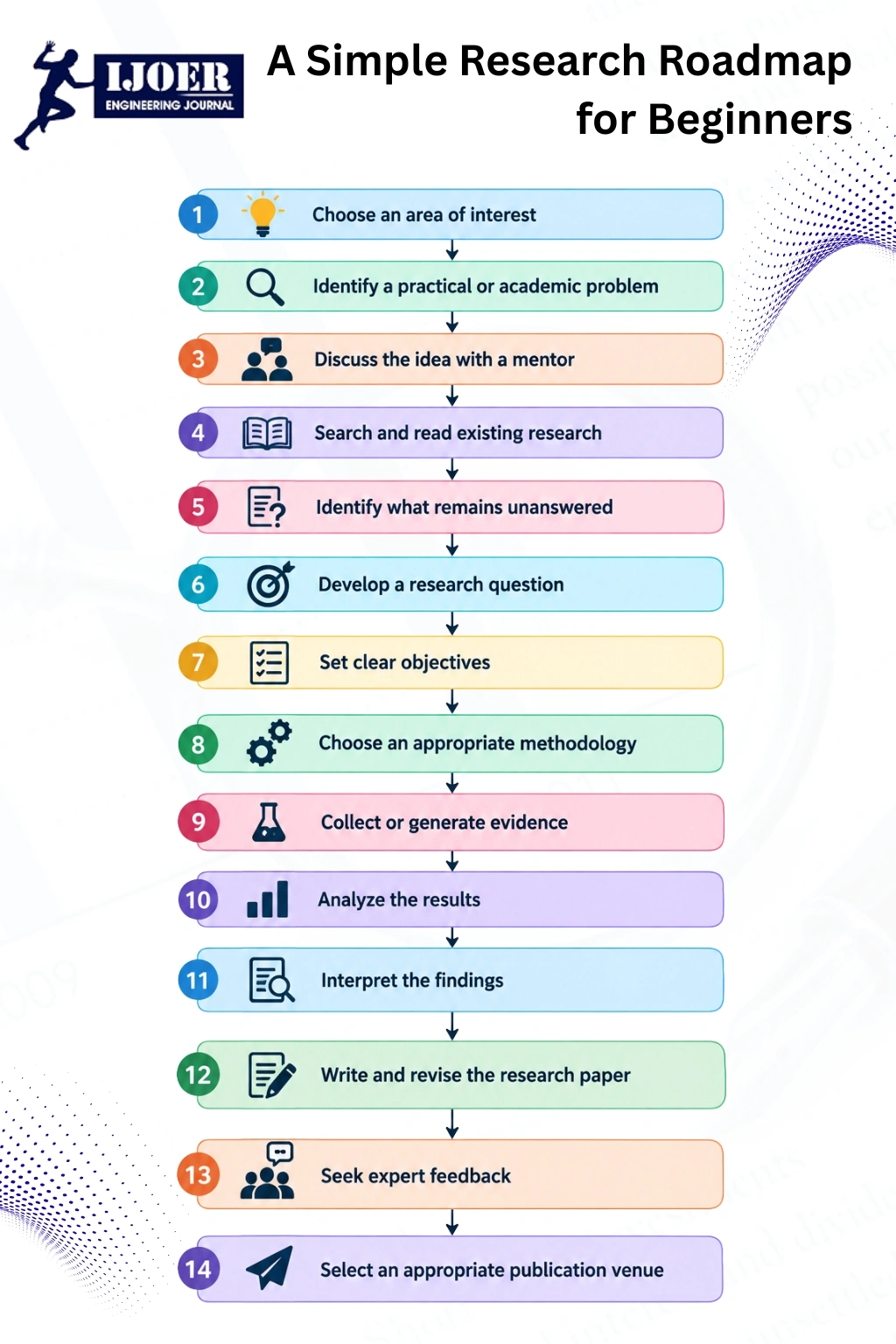
The process may look linear on paper, but real research rarely works that way. You may return to the literature after an experiment, modify your question after analyzing the data, or revise your methodology after discovering a limitation.
That is part of doing research.
Getting started with research as an engineering student does not require you to know everything from day one.
You do not need to begin with a groundbreaking invention or a highly complicated research problem. Start with something you genuinely want to understand.
Read carefully. Ask questions. Find a mentor. Learn how to evaluate previous research. Keep organized records. Be honest with your data. Learn from unsuccessful experiments. Write regularly. Most importantly, remain willing to change your approach when the evidence tells you that something needs to be reconsidered.
Research is ultimately a way of learning how to move from "I wonder why this happens" to "I investigated it, and here is what the evidence shows."
For an engineering student, that transition can be one of the most valuable parts of an academic journey. It develops not only research skills but also curiosity, analytical thinking, technical communication, patience, and the confidence to tackle problems for which there is no ready-made answer.
You do not have to wait until postgraduate study to begin. Your first research project can start with a question you ask today.