Entering 2026: From Laboratory Promise to Industry Reality
Globalization in energy storage has moved from "laboratory promise to industry reality" as we enter 2026. Today, research is shifting away from mere lithium-ion upgrades and toward complex, heterogeneous materials. The goal is to resolve "The 2026 Trilemma": Hyper-scale Sustainability, Structural Integration, and AI-Autonomy.
1. Shift to 2026: Adoption of Solid-State and Interfacial Stability
While 2025 was the pilot line year, 2026 is the adoption year. Scientists have shifted their focus from the mechanics of the electrolyte to the mechanics of the interface.
Nano-Buffer Layers
Current R&D efforts in 2026 employ ALD (Atomic Layer Deposition) technologies that generate ultra-thin layers aimed at compensating for the volume expansion of lithium-metal anodes. This resolves the "stack pressure" problems seen in previous solid-state battery designs.
Silicon-Carbon (Si/C) Composites
General adoption of high-silicon-content anodes begins in 2026. "Wrapping" silicon materials in graphene or carbon tubes has resolved the long-standing problem of 300% expansion, achieving above 900 Wh/L at the cell level.
Hybrid Electrolytes
"A key trend in 2026 is the 'Semi-Solid' method, where semi-solid electrolytes based on non-flammable gel electrolytes combined with ceramic separators are commonly adopted."
— Roland Reeves, Research Director, IDTechEx
While not entirely novel, this is an efficient use of existing technology to extend range.
2. Long-Duration Energy Storage (LDES): The 2026 Grid Backbone
Solar and wind penetration has never been higher. The research theme for 2026 is centered on energy storage for days, not hours.
Iron-Air and "Reverse Rusting"
The Iron-Air battery has become the 2026 gold standard for multi-day energy storage. It exploits the oxidation (rusting) and reduction (reverse rusting) reactions of iron to offer a Levelized Cost of Storage (LCOS) near $20/kWh – well below lithium's floor of $100/kWh.
Bio-Organic Flow Batteries
"Green Data Centers" established in 2026 utilize Aqueous Organic Redox Flow Batteries based on quinones from lignin. These are non-toxic, non-flammable, and scale simply by increasing tank size.
Gravity and Thermal Storage
The year 2026 has seen a revival in mechanical storage systems. "Sand Batteries" and "Concrete Heat Blocks" designed by PhD researchers now demonstrate over 90% efficiency in extracting renewable heat or in round-trip efficiency.
For researchers exploring sustainable energy solutions, understanding sustainable engineering principles provides essential context for LDES deployment.

3. Structural Energy Storage (SES) – Massless Energy
The 2026 paradigm for urban and aerospace engineering is Multifunctional Materials. The aim is to overcome the "parasitic weight" of batteries by storing energy within the structure itself.
Energy-Storing Infrastructure
Building foundations in 2026 are now being cast with conductive cement supercapacitors. "Carbon-Cement" energy storage relies on the surface area of building frameworks to store electrical energy – essentially making a skyscraper a distributed power source, a battery.
Structural Composites in eVTOL
For postgraduate students pursuing aerospace Master's degrees, R&D lies in applying Carbon Fiber Reinforced Polymer (CFRP) technology to serve simultaneously as wing-skin structure and a high-rate supercapacitor. This development is pivotal to the 2026 launch of eVTOL aircraft.
These innovations in structural storage align closely with smart materials and infrastructure research, where multifunctional design is transforming the construction industry.
4. AI-Autonomous Battery Management Systems (BMS)
In 2026, a battery is only as good as the code it contains. Code has now spawned a new academic discipline.
Digital Twin Synchronization
All major energy storage systems in 2026 are synchronized with a Digital Twin – a virtual clone that uses real sensor data to simulate degradation. This allows real-time adjustments to charging routines, prolonging system lifetime by up to 30%.
Physics-Informed Neural Networks (PINNs)
Unlike conventional AI models, 2026 BMS incorporates actual electrochemical laws into the learning model. This enables near-perfect "State of Health" calculations, enabling money to flow into the "Second-Life" sector for home energy storage using EV batteries.
Edge-AI for Safety
Current BMS designs have introduced "Edge AI" chips integrated directly into the battery module. These chips evaluate voltage anomalies at the microsecond level to foresee internal shorts before thermal runaway occurs.
The integration of AI into BMS represents a broader trend in AI in engineering, where intelligent systems are transforming design and operational paradigms.
5. 2026 Global Innovations and Sustainability Trends
The Battery Passport Expansion
As of 2026, both the EU and North America have implemented digital battery passports. Current research is shifting toward Direct Recycling – a process that occurs without melting and preserves the cathode crystal structure, reducing battery manufacturing's carbon footprint by 70%.
Sodium-Ion (Na-Ion) Dominance
Due to pressures on lithium supply chains, Na-Ion batteries entered the budget EV and energy storage markets in 2026. These batteries use only aluminum (a two-sided aluminum current collector instead of copper), making them dominant for developing nations.
For researchers interested in battery materials and publication strategies, top Scopus-indexed journals in engineering and science offer excellent venues for energy storage research.
Hydrogen-Battery Hybrids
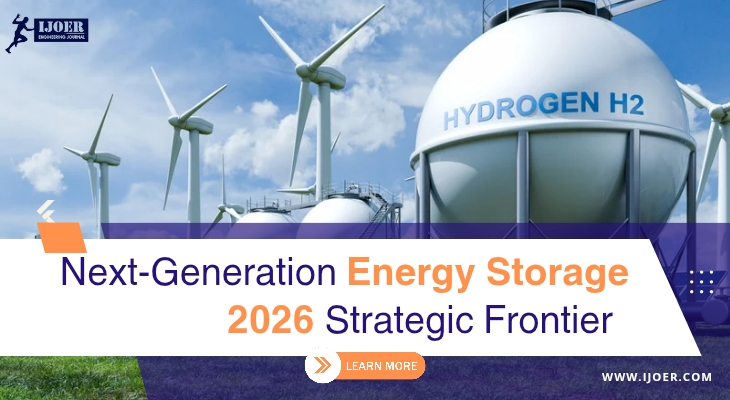
Smoother acceleration in 2026 involves coupling hydrogen fuel cells with small high-rate batteries. Rapid "burst" power demands are met with batteries, while long-distance energy needs are handled by hydrogen.
The Post-Lithium Transition is Here
2026 marks the first time that sodium-ion, iron-air, and solid-state batteries have left the lab and entered commercial pilot stages. The energy storage landscape is no longer lithium-centric – it is becoming diverse, structural, AI-driven, and sustainable.
For researchers, the imperative is clear: design for recyclability, integrate AI from the cell up, and think beyond kWh to system-level outcomes.
These developments echo broader patterns in cyber-physical systems in Industry 4.0, where digital and physical integration drives innovation.