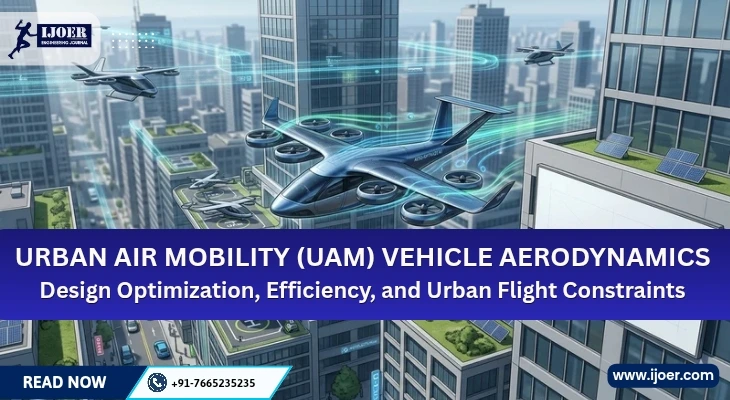
Urban Air Mobility (UAM) represents a paradigm shift in how aviation interacts with cities. Unlike traditional aircraft that operate from remote airports and spend most of their time at high altitudes, UAM vehicles will be required to operate continuously in congested urban areas. This alone transforms aerodynamics from a background engineering discipline into the defining factor of feasibility.
Every promise linked to UAM – faster travel, reduced congestion, lower emissions, and extensible urban transport – ultimately depends on aerodynamic performance. Low-speed lift must be generated efficiently. Drag must be minimized under extreme geometric constraints. Stability must be maintained in turbulent airflow around buildings and through thermal gradients. Noise must be reduced without sacrificing thrust. Energy consumption must stay within the limits of current battery technology.
UAM aerodynamics is not about optimizing a single flight condition. It is about coordinating conflicting aerodynamic requirements across hover, transition, cruise, descent, and landing – all while interacting with an environment never designed for aircraft.
This blog discusses how aerodynamic principles are applied to UAM vehicle design, how optimization models address conflicting requirements, and how urban environments impose constraints that challenge traditional aerospace assumptions.
For researchers exploring advanced aerospace topics, understanding top research areas in space science and astrophysics provides valuable context for broader aerospace innovation.
1. Aerodynamic Foundations of Urban Air Mobility
1.1 The Multi-Regime Nature of UAM Flight
Traditional aircraft are optimized for a single prevailing flight regime. Fixed-wing planes are cruise-optimized. Helicopters are geared toward low speed and hovering. UAM vehicles must perform well in both regimes – and excel in the transitions between them.
This requirement presents a fundamentally different aerodynamic challenge. The aircraft must generate lift using rotors, wings, or a hybrid combination depending on the flight stage. It is impossible to maximize aerodynamic efficiency for one condition without degrading another. Stability characteristics also shift as airflow patterns change around the airframe.
Key aerodynamic regimes in UAM include:
- Hover – Lift generated primarily by rotor-induced flow
- Transition – Rotors and wings both contribute, creating complex interference patterns
- Cruise – Aerodynamic efficiency dominates to minimize energy use
- Approach and landing – Urban winds and ground interaction become critical
Each regime imposes different aerodynamic constraints, yet all must be satisfied by a single vehicle.
1.2 Core Aerodynamic Forces in UAM Vehicles
UAM vehicles are subject to the same basic aerodynamic forces as traditional aircraft, but with significantly stronger coupling between them.
These forces include:
- Lift – From wings, rotors, or hybrid systems
- Drag – Vortex-induced drag and downwash
- Profile drag – Surface friction and pressure differentials
- Interference drag – Propulsion system-airframe interaction
Unlike traditional designs, the same components are often used to generate both thrust and lift. Distributed propulsion makes this coupling even stronger, rendering aerodynamic interactions not secondary but inevitable.
2. Vehicle Configurations and Their Aerodynamic Consequences
2.1 Multirotor Architectures
Multirotor configurations use multiple vertically oriented rotors to provide lift and control forces. Aerodynamically, they are simple in hover but face significant efficiency penalties in forward flight.
Key aerodynamic characteristics:
- High rotor-rotor interaction in downwash
- High induced power demands due to absence of lifting surfaces
- Low aerodynamic efficiency in forward flight
These vehicles are typically limited to short-range operations where aerodynamic inefficiency is tolerated in exchange for operational simplicity.
2.2 Lift Plus Cruise Configurations
Lift-plus-cruise designs separate vertical lift rotors from forward propulsion using fixed wings. This separation allows aerodynamic optimization for different flight regimes.
Aerodynamic benefits:
- Wings produce lift efficiently in cruise mode with lower power requirements
- Vertical rotors are optimized for hover without compromising cruise aerodynamics
- Lower drag in forward flight compared to multirotor designs
However, this configuration creates complex aerodynamic interactions during transition, when rotor wakes interact with wing and fuselage surfaces.
2.3 Tilt Rotor and Tilt Wing Designs
Tilt-based designs deliver among the best cruise efficiencies of any UAM concept. These vehicles rotate their propulsion direction – or entire wings – to match flight phase requirements.
Aerodynamic challenges:
- Highly shear turbulent flow during tilt transitions
- Asymmetric lift and control forces under partial tilt conditions
- Strong coupling between aerodynamic forces and propulsion dynamics
Accurate modeling of transient aerodynamic phenomena is essential for designing these vehicles.
The evolution of UAM configurations parallels developments in robotics and autonomous systems research, where complex vehicle dynamics require sophisticated control approaches.

3. Aerodynamic Design Optimization in UAM
3.1 The Need for Integrated Optimization
Classical aerospace design tends to proceed sequentially. Aerodynamics is optimized first, followed by structures, propulsion, and control. This approach fails for UAM.
Structural weight, energy consumption, noise, and controllability cannot be separated from aerodynamic performance. The optimization process must be interdisciplinary from the start.
3.2 Parametric Design and Early Stage Exploration
UAM design begins with parametric geometry models, where key dimensions are treated as variables rather than fixed decisions.
Parameters may include:
- Rotor diameter and spacing
- Wing span and airfoil aspect ratio
- Fuselage cross-sectional area and surface curvature
By exploring combinations of these parameters, designers can evaluate thousands of configurations before selecting promising candidates for detailed analysis.
3.3 Multidisciplinary Design Optimization Workflow
A typical aerodynamic optimization framework follows a structured iterative process:
Multidisciplinary UAM Aerodynamic Optimization:

Mission Requirements
        ↓
Define Design Variables
        ↓
Aerodynamic Simulation
        ↓
Structural and Energy Analysis
        ↓
Noise and Stability Evaluation
        ↓
Objective Function Assessment
        ↓
Optimization Algorithm
        ↓
Updated Design Variables
        ↺ (Iteration until convergence)
Each iteration refines the design by balancing aerodynamic efficiency against competing constraints.
These optimization workflows align with AI in engineering applications, where intelligent systems are transforming design and manufacturing processes.
4. Aerodynamic Efficiency and Energy Constraints
4.1 Why Efficiency Is Non-Negotiable
The energy limit of UAM is determined by electric propulsion. Unlike fuel-powered aircraft, electric vehicles lack high energy density reserves. Every aerodynamic inefficiency directly reduces range, payload, or safety margins.
UAM efficiency is not voluntary. It is existential.
4.2 Drag Sources in UAM Vehicles
UAM aerodynamic drag comes from multiple sources, often amplified by unconventional configurations.
Major contributors include:
- Induced rotor drag from low-speed flight and hover
- Parasitic drag from exposed structural components
- Interference drag between wings, rotors, and fuselage
- Instability-induced drag from urban turbulence
Drag reduction requires vehicle-wide shaping rather than component-by-component optimization.
4.3 Low Reynolds Number Challenges
UAM vehicles operate at lower Reynolds numbers compared to commercial aircraft. This fundamentally alters flow behavior.
Effects of low Reynolds number include:
- Early flow separation
- High sensitivity to surface roughness
- Reduced maximum lift coefficients
Developing effective airfoils under these conditions remains an active research problem.
5. Aerodynamics of the Urban Environment
5.1 Urban Wind Fields
Cities radically alter airflow. Buildings produce sharp turbulence gradients and recirculation regions that affect aerodynamic stability.
Characteristics of urban winds include:
- Channel effects between buildings
- Accelerated flow over rooftops
- Wake breakdown from tall structures
These effects are short-range, making them difficult to measure and predict.
5.2 Interaction with Built Structures
Unlike conventional aircraft, UAM vehicles regularly operate near surfaces.
Aerodynamic effects include:
- Modified ground effect near walls and rooftops
- Downwash recirculation in confined areas
- Fluctuating pressures around building corners
These interactions must be considered during both vehicle design and vertiport planning.
Urban aerodynamic challenges connect to broader research in digital twins in engineering, where simulation and monitoring are transforming predictive maintenance and operational planning.
6. Aerodynamics Across UAM Flight Phases
6.1 Hover and Vertical Ascent
Rotor aerodynamics dominates hover flight.
Key considerations:
- Rotor-induced velocity distribution
- Interaction between neighboring propulsors
- Power loading efficiency
Hover efficiency critically affects mission viability, as this phase consumes substantial energy.
6.2 Transition from Vertical to Forward Flight
Transition is the most aerodynamically complex phase.
During transition:
- Rotor contributions to lift are gradually replaced by wing contributions
- Flow separation patterns change rapidly
- Control authority requirements evolve
Aerodynamic Transition Dynamics:

Pure Hover
   ↓
Partial Forward Thrust
   ↓
Rotor Wake Interaction with Wings
   ↓
Increasing Wing Lift
   ↓
Decreasing Rotor Lift
   ↓
Steady Cruise Configuration
Failure to manage this phase effectively can compromise safety.
6.3 Cruise Flight
In cruise, the objective shifts to maximizing lift-to-drag ratio.
Aerodynamic priorities include:
- Wing efficiency
- Fuselage streamlining
- Reduction of exposed propulsion elements
Cruise efficiency is essential for maximizing range and minimizing energy consumption.
6.4 Descent and Landing
Landing reintroduces urban constraints.
Aerodynamic challenges:
- Unsteady winds around buildings
- Variable ground effect
- Downwash interaction with vertiport surfaces
These factors demand accurate aero models and integrated control systems.
7. Stability, Control, and Aerodynamic Coupling
Many UAM designs are aerodynamically unstable. Stability is not achieved through passive aerodynamic design but through active control.
This creates tight coupling between:
- Aerodynamic forces
- Propulsion dynamics
- Control algorithms
Control system design must be based on aerodynamic models that can operate in real time.
8. Aeroacoustics and Noise-Driven Design
Noise is not a separate problem. It is an aerodynamic outcome.
Acoustic signatures are determined by rotor blade tip speeds, loading distributions, and wake interactions.
Aeroacoustic noise reduction measures include:
- Distributed propulsion to reduce peak loading
- Optimized blade geometry
- Slower tip speeds with reduced thrust penalties
Effective aerodynamic noise mitigation is required for public acceptance.
9. Future Research Directions in UAM Aerodynamics
UAM aerodynamics cannot be seen as an extension of current aircraft design principles. Instead, it requires entirely new solutions that address the operational complexity of urban flight. As UAM systems move from prototypes to initial deployment, aerodynamic research must expand beyond individual vehicle testing to consider systemic urban factors, energy constraints, and social acceptance.
9.1 High-Fidelity Urban Flow Modeling
Proper modeling of urban airflow conditions is essential. Traditional atmospheric boundary layer models cannot capture the spatial and temporal variability of city airflow.
Future research should focus on multi-scale urban flow models incorporating: city-scale meteorological patterns, neighborhood-scale building-induced turbulence, and vehicle-scale rotor wake interactions. These models must integrate computational fluid dynamics with urban digital twins that simulate real building geometries, materials, and thermal interactions.
9.2 Rotor-Wing and Airframe Interaction Physics
UAM vehicles rely on distributed propulsion systems where multiple rotors interact with wings, fuselage, and each other. These interactions remain poorly understood, especially in unsteady flight regimes.
Priority areas for research include: rotor wake impingement on lifting surfaces, unsteady transitional aerodynamic loading, and propulsor-to-propulsor interference effects. These interactions affect lift efficiency, structural fatigue, noise generation, and control authority.
9.3 Low Reynolds Number Aerodynamic Innovation
UAM vehicles operate at low Reynolds numbers where viscous effects dominate. Laminar transition, flow separation sensitivity, and surface roughness become primary factors.
Research directions include: airfoil families optimized for low Reynolds number multi-regime flight, passive flow control techniques, and active flow control through synthetic jets or boundary layer management.
9.4 Integrated Aeroacoustic Research
Noise remains a critical barrier to public acceptance. Unlike conventional aircraft noise, UAM noise consists of high-frequency tonal components from rotor blade passages and wake interactions.
Future work must integrate aeroacoustics into design optimization by developing predictive models linking aerodynamic loading to acoustic emission, rotor blade designs optimized for both lift and noise, and distributed propulsion patterns that minimize peak acoustic intensity.
9.5 Aerodynamics-Informed Flight Control Co-Design
Many UAM designs are aerodynamically unstable, requiring continuous active control for stable flight. This demands co-design models where aerodynamics and control systems are developed concurrently.
Research questions include: real-time integration of aerodynamic models into control systems, robust control methods that handle urban turbulence and wake disturbances, and adaptive control laws that respond to changing aerodynamic conditions.
9.6 Data-Driven and AI-Assisted Aerodynamic Modeling
The complexity of UAM aerodynamic interactions challenges purely physics-based modeling. High-fidelity simulations are computationally expensive, while simplified models may miss important nonlinear effects.
Hybrid modeling approaches combine physics-based aerodynamic solvers, machine learning models trained on simulation and experimental data, and reduced-order representations suitable for real-time use.
9.7 Urban Ground Effect and Infrastructure Interaction Studies
UAM operations frequently occur near building rooftops and vertiport infrastructure. Ground effect phenomena in these environments differ from open-surface conditions.
Research should examine downwash recirculation in confined urban areas, rotor wake interaction with vertiport structures, and aerodynamic effects on passenger and ground crew safety.
9.8 Aerodynamic Certification and Regulatory Modeling
Current certification frameworks do not accommodate UAM vehicles due to their unconventional designs and operating conditions. New frameworks must be informed by aerospace research.
Key questions include: establishing acceptable stability margins in urban turbulence, defining aerodynamic safety envelopes for autonomous flight, and characterizing failure modes from aerodynamic interaction effects.
9.9 Experimental Validation in Urban Testbeds
Computational analysis must be supplemented by experimental studies. Wind tunnel tests and urban testbeds provide validation data unobtainable through simulation alone.
Future experimental studies should focus on urban wind tunnel experiments with scaled building geometries, full-scale flight tests in realistic urban conditions, and measurement of unsteady aerodynamic loads and acoustics.
10. System-Level Aerodynamic Integration
UAM aerodynamics cannot be addressed in isolation from the larger transportation system. Research must adopt a system-level perspective where vehicle aerodynamics interacts with traffic management, infrastructure, energy networks, and city planning.
This includes studying how aerodynamic constraints affect flight corridor design, wake separation and multi-vehicle interaction, and network-level energy efficiency.
Through such research, UAM can transition from niche applications to a feasible mass transportation system.
Urban Air Mobility is, at its core, an aerodynamic challenge. The intertwined demands of energy efficiency, vehicle stability, and urban flow conditions require breaking from traditional aviation design paradigms.
Successful UAM deployment will depend on rigorous aerodynamic optimization grounded in multidisciplinary research and validated in real-world conditions. As cities grow and their transportation demands increase, aerodynamic innovation will determine whether Urban Air Mobility remains a dream or becomes routine.
For researchers planning to publish in aerospace and advanced mobility domains, top Scopus-indexed journals in engineering and science provide excellent venues for reaching the global academic community.
Further Reading from IJOER
- Top Research Areas in Space Science and Astrophysics for PhD Scholars
- Robotics and Autonomous Systems Research
- AI in Engineering: Transforming Design, Manufacturing, and Innovation
- Digital Twins in Engineering: Transforming Simulation, Monitoring & Predictive Maintenance
- Sustainable Engineering: Building a Greener Future